This article is part of the #ATTD2026 series prepared for the Loop and Learn Newsletter and the Open Source diabetes community. Here you’ll find the full version description of the presentation. Some parts of the text or images may overlap with the version published in Loop and Learn News. You can find the original graphic version of the newsletter here. Loop and Learn News is also available in a text-only version, which — thanks to automatic translations — allows reading in multiple languages and helps make the content accessible to a broader global community. It is also a great option for people with visual impairments. You can find the text only version of the newsletter here. Subscribe to Loop and Learn News here.
LESSONS FROM OPEN-SOURCE SYSTEMS by Sufyan Hussain
A well-known UK clinician and researcher in advanced diabetes therapies, including AID systems and islet transplantation, Sufyan Hussain opened the session by bringing together both professional expertise and more than 35 years of personal experience living with type 1 diabetes. As a user of multiple AID systems himself, including open-source solutions, he offered a perspective shaped by both medicine and real life.
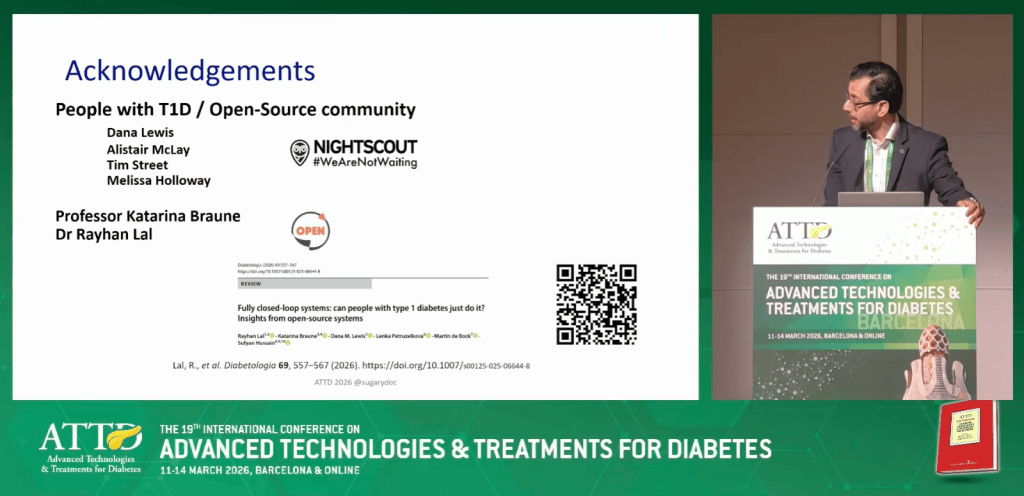
At the start of the session, Sufyan Hussain acknowledged the open-source diabetes community and the work of key collaborators, including Katarina Braune and Rayhan Lal, as well as the broader OPEN consortium. He noted that many of the concepts discussed were grounded in a recent Diabetologia publication that served as an important scientific foundation for the session.
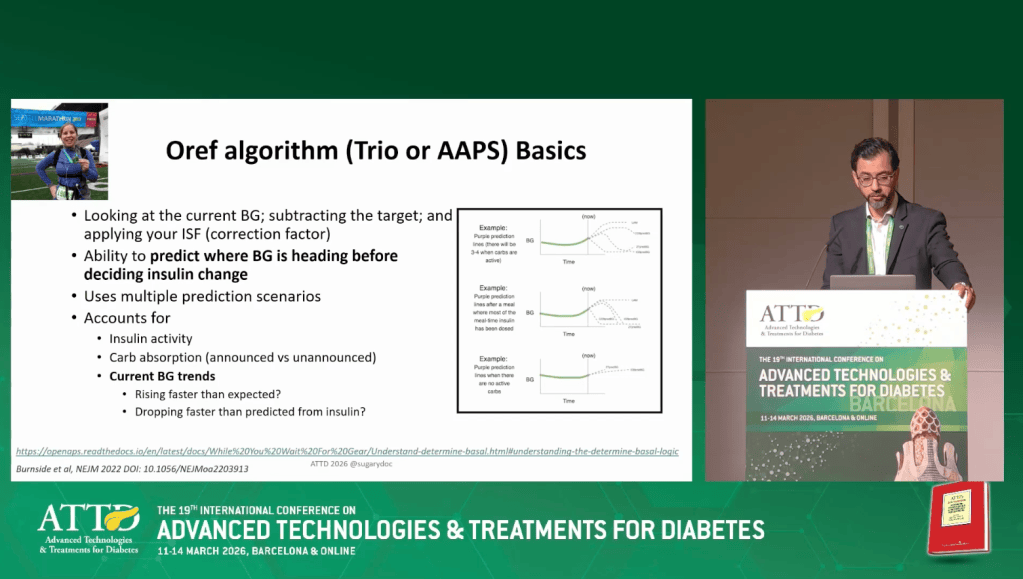
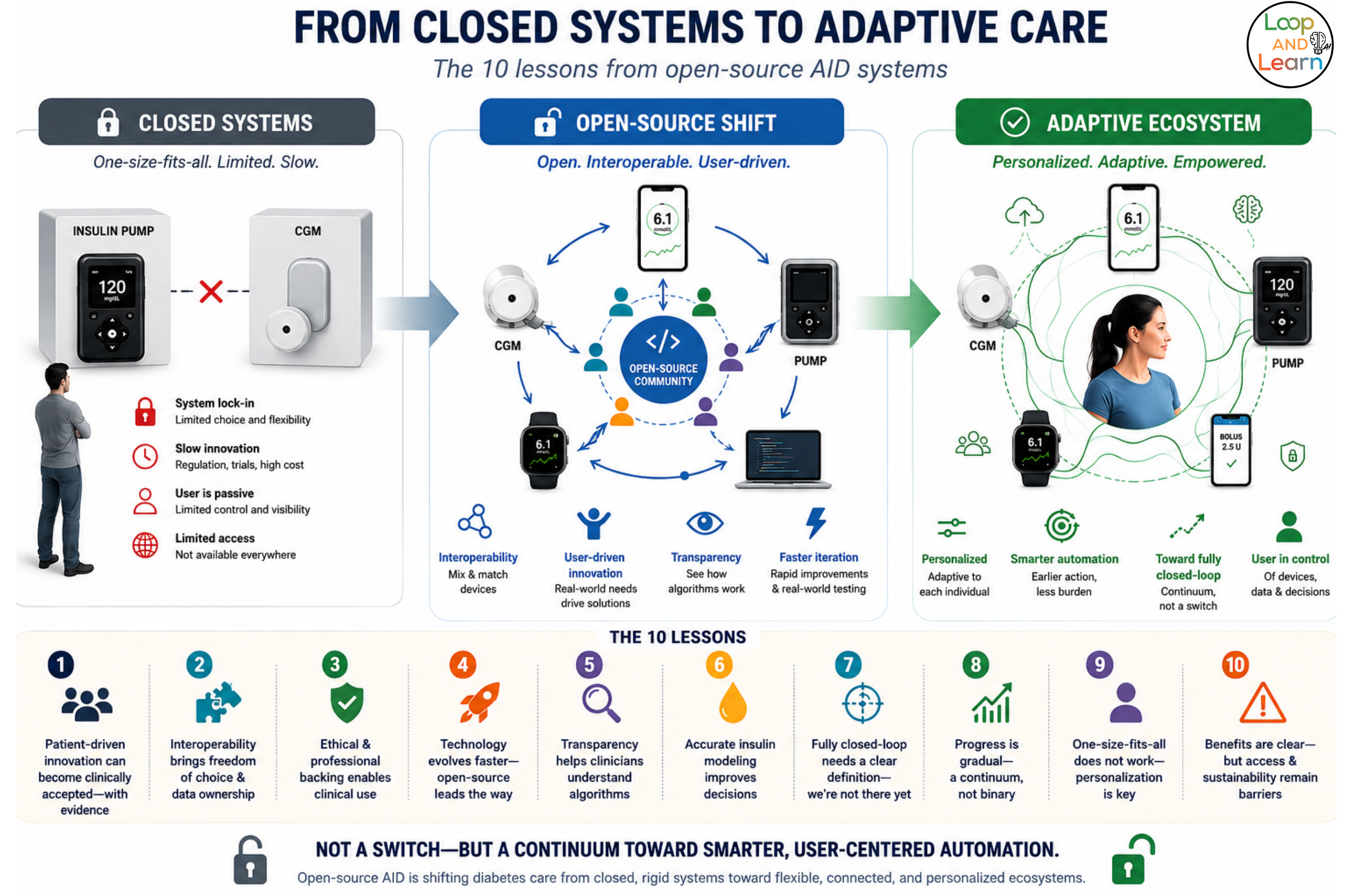
He positioned the talk as a concise introduction to open-source AID systems, structured around ten key lessons — ranging from technical insights to broader high-level concepts — before moving into the overall conclusions.
Lesson 1: Open-source AID systems show that patient-driven innovation can become clinically accepted—if supported by evidence.
- Started as DIY solutions connecting pumps + CGM
- Faced strong skepticism from academia
- Turning point came with:
- International Consensus Statement (17 organizations)
- RCT evidence (NEJM) showing safety & efficacy
- FDA-related work (Tidepool Loop)
- Publications in major journals (Lancet, Nature)
Lesson 2: Interoperability = freedom of choice, remote control, and user ownership of data.
- Open-source AID allows mixing different CGMs and pumps
- Enables use of devices not supported by commercial AID systems
- Expands access in countries with limited availability
For users:
- More choice (not locked into one system)
- More flexibility (watch control, remote bolus, text-based commands)
- Useful for parents/caregivers managing remotely
Bigger picture:
- Introduces data agency → users control their own data
- Important for future AI + trust + transparency
Open-source AID removes system lock-in and gives users control—not just of devices, but of their data.
Lesson 3: Open-source AID now has ethical and professional backing for clinical use.
- International consensus statements provide guidance for clinicians
- Enables safe support of open-source systems in practice
- Based on ethical principles and informed decision-making
- Helps address legal concerns around use
Key point: Clinicians can support open-source AID—if patients are informed and risks are understood.
Lesson 4: Technology evolves faster than clinical adoption—but open-source shows a faster path.
- Traditional medicine is slowed by regulation, trials, and cost
- Creates a gap between what is possible and what is available
- Open-source enables faster iteration and user-led improvements
- Focus on usability and real-world testing
Key point: Open-source highlights a model for faster, lower-cost innovation, with potential to improve global access.
Lesson 5: Open-source AID provides transparency—helping clinicians understand how algorithms actually work.
- Access to code/pseudocode gives insight into:
- how dosing decisions are made
- what assumptions systems rely on
- when and why systems may fail
- Improves ability to:
- predict system behavior
- manage complex clinical scenarios (e.g. gastroparesis, dialysis)
Key point: Transparency improves understanding—something currently limited in commercial systems.
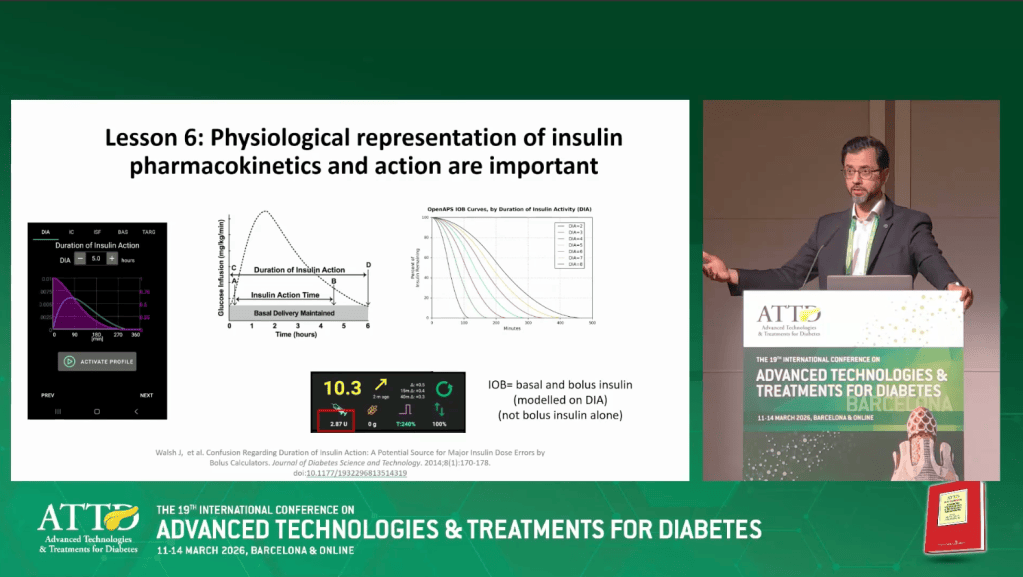
Lesson 6: How insulin is visualized matters—and current models can be misleading.
- Commercial systems use active insulin time (linear decay) → may underestimate remaining insulin
- Open-source uses duration of insulin action (curved, longer tail) → more realistic
- Open-source also shows total insulin on board (basal + bolus combined)
- Commercial systems often show bolus only, missing full picture
Key point: More accurate insulin modeling improves decision-making, especially during activity or unexpected changes.
Lesson 7: Fully closed-loop needs a clear definition—and we’re not there yet.
- “Fully closed-loop” is often used loosely
- Proposed definition:
system that can be set-and-forget for days
handles meals, exercise, stress, illness automatically - Reality today:
- Most systems = AID without meal announcement
- Not truly fully closed-loop
Key point: Fully closed-loop is the goal—but current systems are still hybrid.
Lesson 8: Movement toward a fully closed-loop is gradual—not binary.
- It’s a continuum, not “AID vs fully closed-loop”
- Users already operate in-between:
- minimal interaction
- occasional manual bolus when needed
- Key innovation from open-source:
- earlier insulin delivery
- unannounced meal detection (based on glucose rise patterns)
- super microboluses (small, frequent doses replacing large corrections)
Key point: Progress is stepwise—systems act earlier and more gradually, moving toward automation without fully replacing user input yet.
Lesson 9: One-size-fits-all AID does not work for everyone—personalization is key.
- Standard settings may provide basic control, but limit outcomes
- Advanced goals (e.g. handling unannounced meals) require adjusted parameters
Key point: Future AID systems must be personalized, not standardized, to achieve optimal results.
Lesson 10: Open-source AID offers benefits—but access and usability remain barriers.
- Used in only 5–10% of practice
- Requires time, effort, and technical skills
- Limited clinical support and guidance
- Not as simple as commercial “out-of-the-box” systems
Key point: Adoption is limited by complexity and support gaps—wider use requires better guidance and easier onboarding.
Conclusion: Open-source AID represents a unique model of co-creation in medicine, enabling interoperability, device choice, and access, while its transparent architecture supports learning, customization, and innovation—now making it clinically supportable and offering early insights into advanced meal handling and the path toward fully closed-loop systems.
 #type1dmaniac