This article is part of the #ATTD2026 series prepared for the Loop and Learn Newsletter and the Open Source diabetes community. Here you’ll find the full version description of the presentation. Some parts of the text or images may overlap with the version published in Loop and Learn News. You can find the original graphic version of the newsletter here. Loop and Learn News is also available in a text-only version, which — thanks to automatic translations — allows reading in multiple languages and helps make the content accessible to a broader global community. It is also a great option for people with visual impairments. You can find the text only version of the newsletter here. Subscribe to Loop and Learn here.
Fasting exists in many religions, but the length, rules, and purpose vary widely. In Christianity, the longest fasting period is Lent (about 40 days), though it is usually a partial fast, such as giving up certain foods (e.g., meat or sweets) or reducing meals on specific days. In Judaism, several fast days are observed each year, including Yom Kippur, which involves a continuous ~25-hour fast with no food or drink—shorter in duration but very strict.
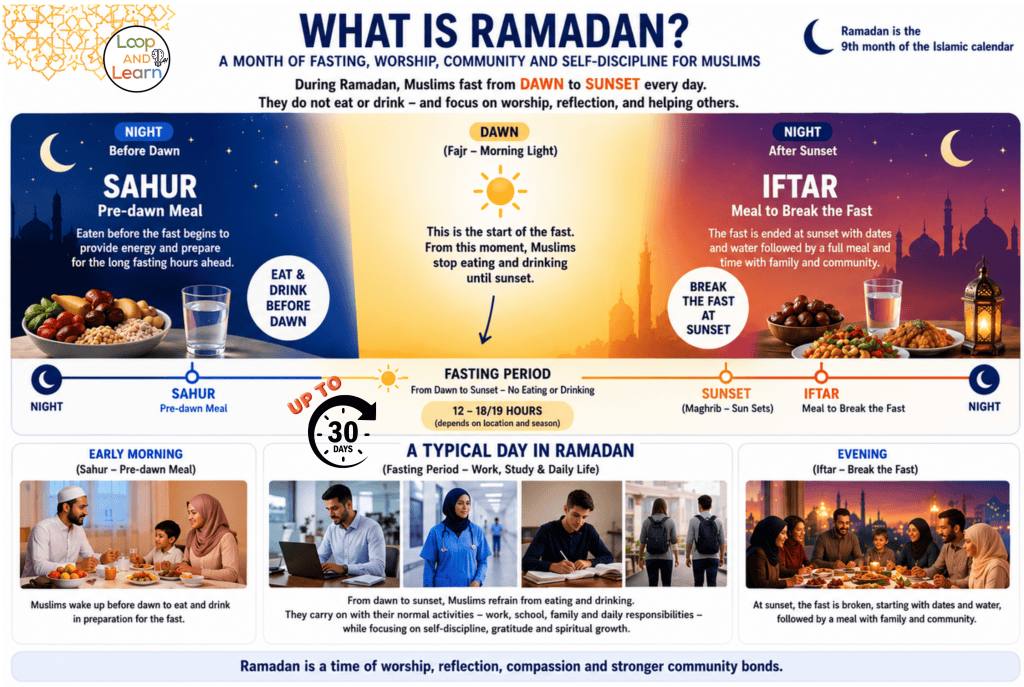
In contrast, Ramadan in Islam is one of the most structured and demanding daily fasting practices, with fasting from dawn to sunset for up to 30 consecutive days. This makes it unique—and offers valuable insights, particularly in understanding diabetes management during fasting.
What stayed with me from Presentation FASTING DURING RAMADAN WITH AID SYSTEMS led by Mohammed Al-Sofiani, leading expert in diabetes and Ramadan research from King Saud University (Saudi Arabia):
“Ramadan fasting represents one of the largest natural experiments in intermittent fasting worldwide. Every year, approximately 160 million people with diabetes attempt to fast. Yet, most evidence and guidelines, historically discouraged fasting for people with high point diabetes, and during Ramadan, Muslims abstain from eating and drinking from dawn to sunset for 29 to 30 consecutive days.”
Al-Sofiani presented a journey he has been on for the past 6 years focusing on Ramadan fasting for people with type 1 diabetes.
“And fasting during Ramadan is not just about food restriction, but it also involves abrupt and substantial changes in sleep patterns, meal timing, and composition, as well as level of physical activity. These abrupt and substantial changes in lifestyle create a unique metabolic environment and complex challenges.”
During Ramadan, data show that time above range (hyperglycemia) increases, while time below range (hypoglycemia) remains stable or may even decrease, compared to before and after Ramadan. This is notable, as one might expect more hypoglycemia during prolonged fasting.
However, analysis across three consecutive years of CGM data shows the opposite: hyperglycemia increases during Ramadan. The main driver appears to be a strong fear of hypoglycemia, leading people with type 1 diabetes to adopt hypoglycemia-avoidance behaviors. This includes proactively reducing insulin doses, both basal and bolus. Importantly, this behavior is not only patient-driven—it is also influenced by clinical recommendations and established guidelines, such as those from the International Diabetes Federation and the Diabetes and Ramadan (IDF-DAR) Alliance, which emphasize reducing hypoglycemia risk during Ramadan.
As a result, strategies aimed at preventing hypoglycemia may unintentionally lead to increased hyperglycemia.
Al-Sofiani explained: “The recommendation states that basal insulin dose should be reduced by 15 to 30% during Ramadan in individuals, as well as short acting insulin doses, especially for Sahour meal, the predawn meal, should also be reduced by 25 to 50%”.
Based on these findings, the speaker highlighted the need to reconsider the current focus on hypoglycemia and move away from standardized insulin reduction strategies toward a more individualized, data-driven approach. He also pointed out that existing tools, such as the IDF-DAR risk calculator, do not differentiate between treatment types—assigning similar risk to MDI, insulin pumps, and more advanced systems—highlighting the need for more personalized risk assessment.
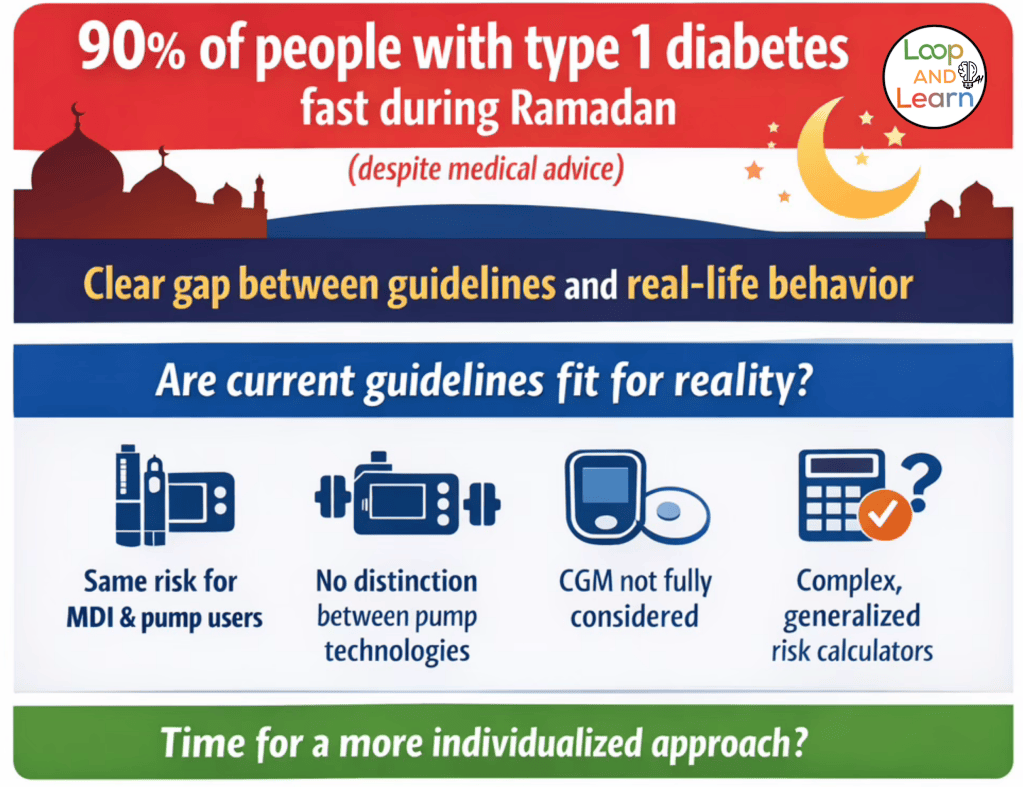
Recent updates from the American Diabetes Association (ADA) now begin to differentiate between treatment types, assigning lower risk to users of AID systems, CGM, and more advanced pump technologies. Building on new data, the speaker emphasized that pre-Ramadan CGM metrics are strong predictors of fasting outcomes, supporting a move away from complex, generalized tools toward a simplified, individualized risk calculator. The proposed next step is a machine learning–based prediction model using pre-Ramadan CGM data to guide decision-making.
Further results are expected to be presented at the upcoming ADA meeting in New Orleans – stay tuned!
 #type1dmaniac