The need for Interoperability by Johan Jendle
This article is part of the #ATTD2026 series prepared for the Loop and Learn Newsletter and the Open Source diabetes community. Here you’ll find the full version description of the presentation. Some parts of the text or images may overlap with the version published in Loop and Learn News. You can find the original graphic version of the newsletter here. Loop and Learn News is also available in a text-only version, which — thanks to automatic translations — allows reading in multiple languages and helps make the content accessible to a broader global community. It is also a great option for people with visual impairments. You can find the text only version of the newsletter here. Subscribe to Loop and Learn here.
Johan Jendle returned to one of the most important — and often underestimated — topics in modern diabetes care: interoperability. In his talk, he described interoperability in its simplest form as the ability of different systems, devices, and platforms to exchange and meaningfully use data together. While diabetes technology has advanced rapidly over the years — with increasingly sophisticated insulin pumps, CGM systems, apps, and data platforms — many of these tools still operate in isolated ecosystems.
According to Jendle, this fragmentation remains one of the major barriers limiting the full potential of diabetes technology. When devices cannot communicate freely, people living with diabetes are often forced to manually bridge the gaps themselves — between apps, platforms, reports, healthcare providers, and daily decisions.
His message was clear: the future of diabetes care is not only about developing better devices, but about ensuring those devices can work together seamlessly around the person using them.
Johan Jendle also highlighted how diabetes care is becoming increasingly connected. Insulin pumps, CGM systems, smart pens, glucose meters, and digital platforms now generate enormous amounts of data that people with diabetes depend on every single day. Yet despite this technological progress, the ability to seamlessly combine and use that data across devices remains surprisingly limited. Many systems still operate through proprietary platforms and closed interfaces, meaning that devices may be technically advanced, but are not truly designed to work freely together.
He pointed out that the growing movement toward open APIs and broader data integration initiatives reflects an important shift in thinking. There is increasing recognition that true interoperability — not only within a single company ecosystem, but between different devices and manufacturers — is still missing, even though it is essential for unlocking the real value of modern diabetes technology. Without that openness, much of the burden continues to fall on people living with diabetes, who are often left trying to manually connect systems that should already be communicating seamlessly.
A key part of Johan Jendle’s message focused on the way diabetes data moves — from devices to users, to healthcare professionals, and potentially even beyond. While sharing data with clinicians, family members, or caregivers is generally seen as beneficial and widely accepted, he emphasized that further data sharing introduces far more complex ethical questions. This becomes especially sensitive when information is transferred to research institutions, commercial companies, or external platforms without people fully understanding where their data goes, who can access it, or how it may ultimately be used. His talk highlighted that interoperability is not only a technical challenge, but also a question of transparency, trust, consent, and user control. As diabetes technologies become increasingly connected and data-driven, ensuring that people remain informed and in control of their own information becomes just as important as the technology itself.
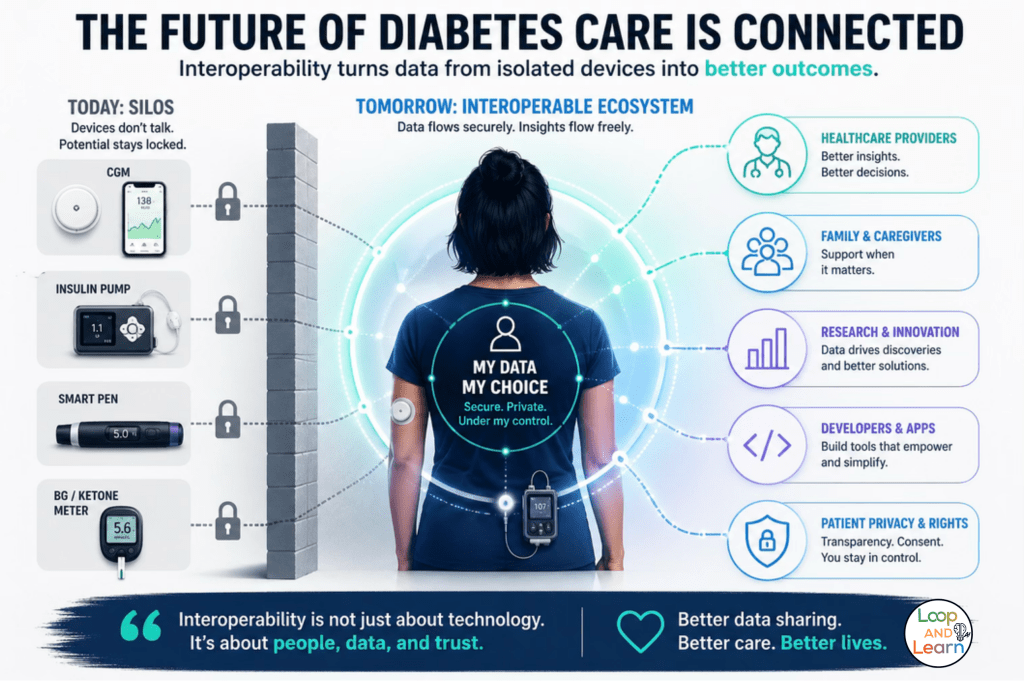
Johan Jendle repeatedly returned to one of the most sensitive and still unresolved questions in modern diabetes technology: data ownership. He pointed out that it remains surprisingly unclear who truly owns diabetes data — whether it belongs to the person living with diabetes, the healthcare provider, the institution storing the information, or the manufacturer of the device generating it.
According to Jendle, this ambiguity creates significant ethical, legal, and regulatory challenges, especially when data begins to move beyond direct clinical care. The use of diabetes data for research, algorithm development, commercial partnerships, or broader industry purposes raises important questions about consent, transparency, and control. His message underscored that as diabetes care becomes increasingly dependent on data, the conversation can no longer focus only on technology itself. It must also address who benefits from that data, who has access to it, and whether people living with diabetes truly remain at the center of those decisions.
Another major topic in Johan Jendle’s presentation was the complexity of integrating diabetes data into broader healthcare systems. While the value of having glucose, insulin, and therapy data directly available within electronic health records is increasingly clear, making this work in practice remains extremely challenging. Technical incompatibilities, limited standardization, regulatory requirements, and financial barriers all complicate the process. He explained that differences between platforms often require multiple intermediaries just to move data from one system to another, disrupting interoperability while simultaneously increasing costs and complexity. He also explored the broader regulatory landscape surrounding diabetes data, highlighting major differences between regions — particularly between Europe and the United States — in how data ownership, privacy, and access are approached. Regulations such as GDPR, the European Data Act, and emerging AI frameworks are beginning to reshape the environment even further. According to Jendle, this creates an increasingly difficult balance: enabling meaningful access to data while still protecting privacy, security, and user rights. His talk made clear that the future of interoperability will depend not only on technological progress, but also on how societies choose to navigate these legal, ethical, and regulatory tensions.
In his conclusion, Johan Jendle emphasized that diabetes care is rapidly moving toward a future built around big data, artificial intelligence, and increasingly connected systems. But according to him, technological progress alone will not be enough. The future will depend on whether healthcare systems can create both openness and trust at the same time. He stressed that true interoperability requires far more than simply connecting devices. It also depends on clear technical standards, secure handling of sensitive health data, transparent governance, and respect for patient consent and ownership. Ultimately, his message centered on balance: making diabetes data accessible enough to improve care, research, and innovation, while ensuring that the people generating that data remain protected, informed, and in control.
 #type1dmaniac