This article is part of the #ATTD2026 series prepared for the Loop and Learn Newsletter and the Open Source diabetes community. Here you’ll find the full version description of the presentation. Some parts of the text or images may overlap with the version published in Loop and Learn News. You can find the original graphic version of the newsletter here. Loop and Learn News is also available in a text-only version, which — thanks to automatic translations — allows reading in multiple languages and helps make the content accessible to a broader global community. It is also a great option for people with visual impairments. You can find the text only version of the newsletter here. Subscribe to Loop and Learn here.
The speech was presented by Revital Nimri, a senior endocrinologist and leading expert in diabetes technology from Schneider Children’s Medical Center of Israel.
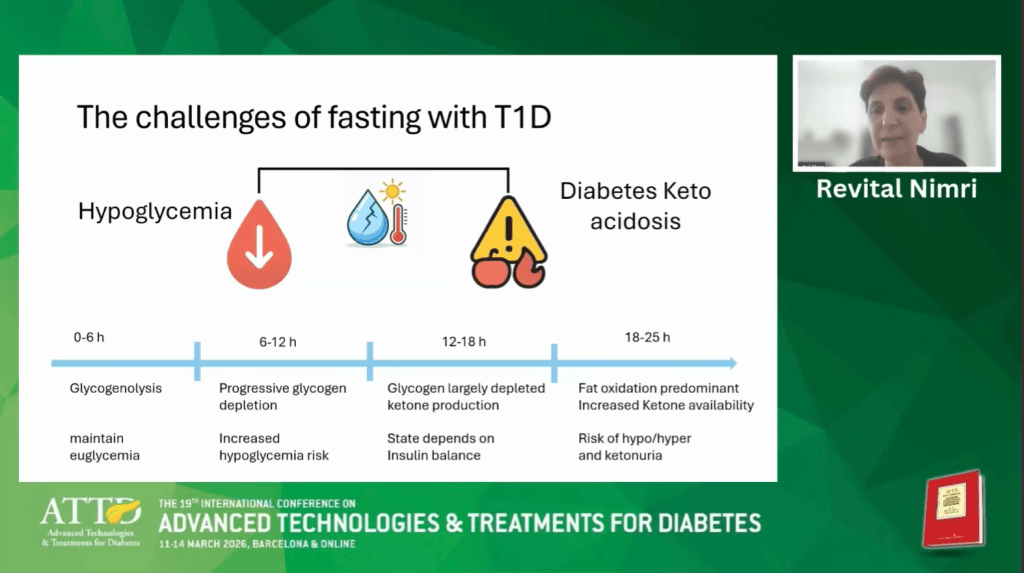
Yom Kippur fasting, the Jewish day of atonement, which, despite sharing religious significant represent a different metabolic and technological challenge. It’s a single continuous fast of approximately 25 hours, including overnight, no food, no fluid intake. Traditionally, because of the risk and in line with the current guidelines the recommendation has been not to fast. But with the increasing use of AID system, the question came up again. There was no data to guide us, we decided the only way to win an argument was to generate some evidence. The metabolic changes normally occur during fasting which makes insulin dependent diabetes management more challenging.
“But importantly, this risk is not explained by insulin exposure alone. Experimental data show that fasting per se, compared with the fed state, significantly empire or reduce glucagon secretion and endogenous glucose production in people with T1D. Significantly, by approximately 40%, which may increase susceptibility to hypoglycemia and make prolonged fasts, such as the 25-hour Yom Kippur fast, particularly challenging.”
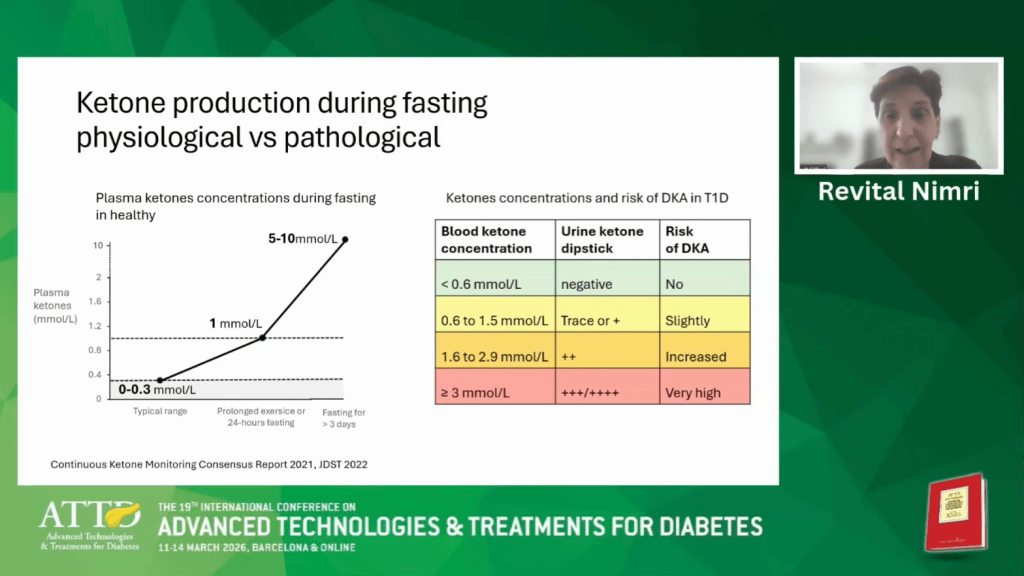
In healthy people, the body naturally produces ketones during fasting. Even during longer fasting, ketone levels can rise (up to about 1–1.5 mmol/L), and this is normal and safe. However, in people with type 1 diabetes, higher ketones may signal not enough insulin in the body, which increases the risk of diabetic ketoacidosis (DKA). Even with normal sugar levels. That’s why longer fasts (like a ~25-hour fast) are important to study: to see how ketones behave and whether they stay in a safe range. The challenge is that there is still limited research on ketone levels during fasting in people with type 1 diabetes.
Overnight studies show that ketone levels are usually low, but can be higher in younger children. During longer fasting, ketones increase but generally stay within normal ranges.
However, ketone levels above ~0.8 mmol/L after overnight fasting may be linked to a higher risk of DKA later. This study aimed to see whether AID systems can safely manage prolonged fasting in people with type 1 diabetes—by looking at: glucose control, ketone levels at the end of fasting and how insulin delivery changes.
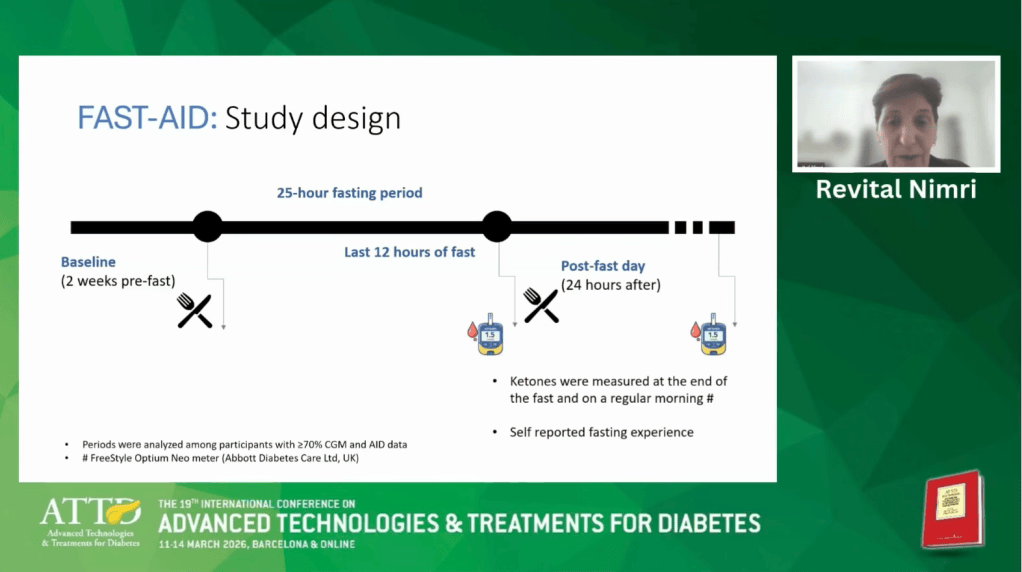
Participants were recruited through routine care before the fast, and data were collected before, during, and after the fasting period.
The study included 54 adolescents and young adults (age ~12–28) using a mix of insulin delivery systems:
- ~36 participants (≈67%): Medtronic MiniMed 780G
- ~9 participants (≈17%): Control-IQ
- ~9 participants (≈17%): open-source AID systems (Loop, Trio, iAPS)
Participants started from a stable baseline, with average HbA1c of 6.8% and Time in Range ~73%, reflecting a broad spectrum of real-world experiences.
We’d like to highlight open-source AID users were fully included and represented (~17%), alongside commercial systems—highlighting that open-source solutions are now part of clinical evidence, not outside of it.
Different systems showed different patterns:
- 780G users: often used exercise targets or stayed on standard automation
- Control-IQ users: mainly relied on sleep mode, sometimes combined with adjustments
- Open-source users: applied the most individualized strategies, adjusting basal rates and glucose targets dynamically
Outcomes
Across all algorithm types:
- Time in Range improved significantly during fasting
- Improvement driven by reduction in hyperglycemia
- No increase in hypoglycemia
- No severe adverse events
Differences between systems were small, with comparable overall outcomes, though Open-source users demonstrated alongisde outcomes aligned with commercial systems, the highest flexibility in adjustments, offering more tailored personalization of system to the users.
Also this study approves that all AID approaches—commercial and open-source—support the safe fasting in real-world conditions. And importantly:
Open-source is no longer “alternative” — it is represented, measured, and performing alongside commercial systems in clinical research.
Earlier studies (with older technologies) required significant insulin reduction to maintain safety during fasting—often increasing the risk of hypoglycemia.
In contrast, this study shows that individuals starting from a stable baseline using AID systems can fast safely, with: minimal insulin adjustment, higher Time in Range, no increase in hypoglycemia or ketones. AID systems appear to offer a safer approach to fasting (although direct comparison between modalities was not the primary aim).
Revital Nimri concluded that AID systems can support safe fasting in people with type 1 diabetes, maintaining glucose in range with only modest adjustments. They emphasized the importance of adequate insulin delivery, as excessive reduction increases ketone risk.
Importantly, these findings may warrant a reconsideration of current fasting guidelines for individuals using AID—including those using open-source systems.
 #type1dmaniac