Presented at ATTD 2026 by Tim Street
This article is part of the #ATTD2026 series prepared for the Loop and Learn Newsletter and the Open Source diabetes community. Here you’ll find the full version description of the presentation. Some parts of the text or images may overlap with the version published in Loop and Learn News. You can find the original graphic version of the newsletter here. Loop and Learn News is also available in a text-only version, which — thanks to automatic translations — allows reading in multiple languages and helps make the content accessible to a broader global community. It is also a great option for people with visual impairments. You can find the text only version of the newsletter here. Subscribe to Loop and Learn here.
Tim Street is also known for his ability to openly talk about the realities behind diabetes management — including the imperfections, uncertainty, and mental load that numbers alone often fail to show. Within the open-source community, he has become a respected voice not only because of technical knowledge, but because he consistently connects technology with real-life experience. His sessions are appreciated for being practical, honest, and deeply grounded in everyday life with diabetes, rather than focused only on theory or idealized outcomes.
One of the central points in Tim Street’s presentation was just how complex meal dosing really is. Calculating insulin for food is challenging because it attempts to replace an incredibly sophisticated biological feedback system — involving both insulin and glucagon — with manual human decisions. In reality, dosing is influenced by far more than carbohydrates alone. Meal composition, fat and protein content, digestion delays, insulin sensitivity, timing, stress, activity, and simple human estimation errors all play a role. Tim highlighted studies showing that even in controlled settings, people miscalculate carbohydrates by roughly 15 grams on an average 72-gram meal, with errors sometimes reaching 20 grams or more. That level of variability helps explain why so many people look for additional support tools to improve dosing decisions. He also explored the growing interest in large language models (LLMs) and AI-assisted meal estimation. While these tools are becoming increasingly capable, their accuracy still varies significantly with more complex foods and situations. His message was clear: these technologies may become valuable decision-support tools, but they are not a replacement for human judgment or lived experience.
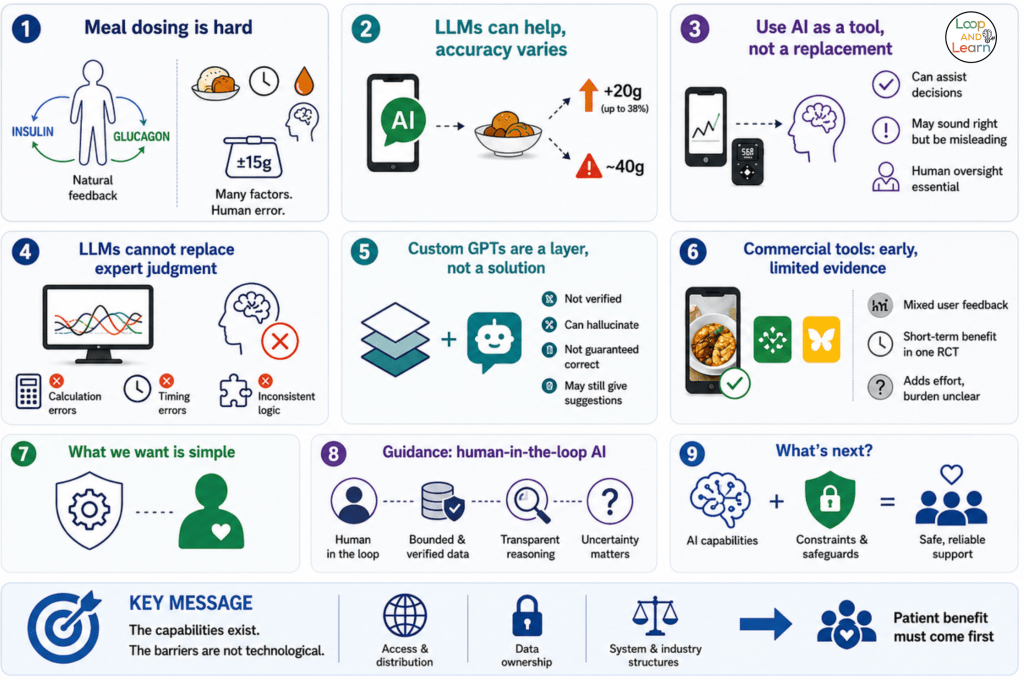
Across multiple studies—including a live on-site test— A critical finding was that while dietitians tended to underestimate (reducing risk of overdosing), AI models—especially Gemini—overestimated by >20g in up to 38% of cases; with errors reaching ~40g, AI carb counting is not yet reliable enough for insulin dosing and must be verified by humans, particularly if considered for integration into AID systems. People increasingly use AI as a “digital endocrinologist,” uploading CGM data and pump settings to get advice. However, these models are designed to produce fluent, confident responses—not to reliably analyze medical data—often skipping inputs or misinterpreting patterns. As a result, recommendations may sound correct but be misleading. In practice, any changes should remain cautious (around ~10%, as in standard self-adjustments), with human oversight essential. A simulation study comparing reinforcement learning and large language models on virtual patients showed similar real-world issues—errors in calculations, timing, and inconsistent logic—highlighting LLMs cannot safely replace the expert judgment required to set insulin pump parameters—and while that expertise doesn’t have to come from a clinician, it should not come from a language model.
So what next in the large language model world? Custom GPTs. But those are just a layer on top of the same model—they change tone, instructions, or sources, but not how the model reasons.
They cannot verify outputs, avoid hallucinations, or ensure correctness, even if they claim to. Some tools may still provide insulin-related suggestions despite disclaimers, which raises safety concerns. They may sound confident, but that is fluency—not accuracy or reliability. Commercial players like Dexcom and Abbott have already entered this space with tools such as Smart Food Logging and Libre Assist, but real-world evidence is still limited. Early user feedback—mainly from informal sources like Reddit—has been mixed to negative. One RCT (Snatch) showed a short-term improvement in Time in Range (+6.6%), but with significant limitations: it required specific conditions (e.g. expensive iPhone, food placed on a white plate) and benefits did not persist once users stopped using the tool.
The key issue: these tools add effort without reliably reducing burden, and it remains unclear whether constant food tracking actually helps—or may even create new challenges.
The speaker was clear: What we want is simple. Technology that works safely in the background, supports decisions, and truly reduces burden—without compromising user safety. Today’s tools still require active input and do not reliably reduce the burden of diabetes management. In response to this, UK DTN (Diabetes Technology Network) guidelines now help clinicians discuss the use of LLMs with patients, emphasizing that these tools must be used cautiously. They clearly state that AI should operate with a human in the loop, rely on bounded and verified data sources, be transparent in its reasoning, and explicitly indicate when it is uncertain or does not know. The goal is not to reject AI, but to ensure it earns trust through safety and reliability. Looking ahead, the speaker stressed that effective solutions will require hybrid models, not standalone LLMs—systems that combine AI capabilities with constraints and safeguards.
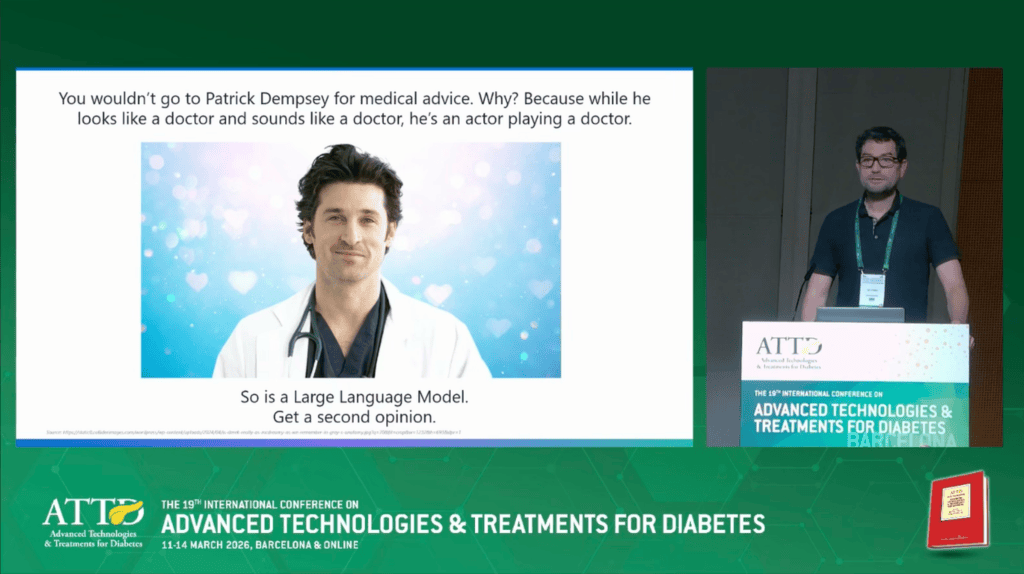
“Do you remember where McDreamy was from, Grey’s Anatomy? He was a surgeon, wasn’t he? But McDreamy was played by Patrick Dempsey, the actor. And that’s important because he talked like a doctor. He walked like a doctor. He carried a stethoscope like a doctor. He could do surgery, at least I saw him doing surgery on the TV. But would I go to him and ask him, would I go to Patrick Dempsey and ask him to do surgery on me? Well, of course I wouldn’t. Because Patrick Dempsey’s an actor, and he can’t do surgery. Well, so is a large language model. So get a 2nd opinion.”
 #type1dmaniac