Earlier this year, we hosted an INNODIA INPACT community event titled “Tzield Journeys: Real Lives, Real INPACT.”
As I wrote in Part I — Aubrey’s story, this wasn’t a lecture or a scientific presentation. It was an open space for families to share what it really means to access Tzield (teplizumab), the first therapy approved to delay the onset of stage 3 type 1 diabetes.
Today I share the second story: Jaime Lucove from California. Diagnosed with type 1 diabetes at the age of three, Jaime has now lived with t1d for 41 years. She is an epidemiologist working in a type 1 diabetes non-profit, and a mom of two children (15, 12). In 2024, her son Carter received Tzield after testing positive for multiple diabetes-related antibodies.
Jaime began her sharing by looking back on her own childhood with diabetes. At that time, management was very different from what families know today. No glucose meter — no way to know actual blood sugar levels. The only available method was urine testing, which could show if glucose was very high, but nothing more precise. Low blood sugars were treated purely based on symptoms: feeling shaky or tired meant it was time for juice.
For many years she used animal insulin, regular and NPH, before modern insulins became available in her late teens. Despite these limitations, she played soccer, softball, and basketball competitively, and did well in school. Her experiences living with diabetes inspired her choice of career.
We’ve come a very long way with the treatments that are now.
Thinking about her kids and screening
When Jaime was expecting her son Carter, the pregnancy was considered high-risk because of her type 1 diabetes. She was told that his chance of developing the condition was around 4% — “which seemed quite low“.
After Carter was born, no one mentioned antibody screening. It wasn’t until years later, through Facebook diabetes groups, that Jaime even learned screening was possible. Back then, however, she chose not to pursue it. Since there was no treatment available, knowing antibody status felt like information without action.
She reassured herself that she would recognize the warning signs if diabetes appeared — excessive thirst, frequent urination, the symptoms every parent in the T1D community knows too well. “I figured, I’ll know when it happens, because I know the signs,” she said.
Everything shifted when Tzield was approved. For the first time, there was a therapy that could delay progression to stage 3. Looking back, Jaime reflects that if she had understood that research studies were already ongoing, she would probably have screened her children earlier — not only for their benefit, but also to contribute to the science that was advancing in the background.
Screening and difficult news
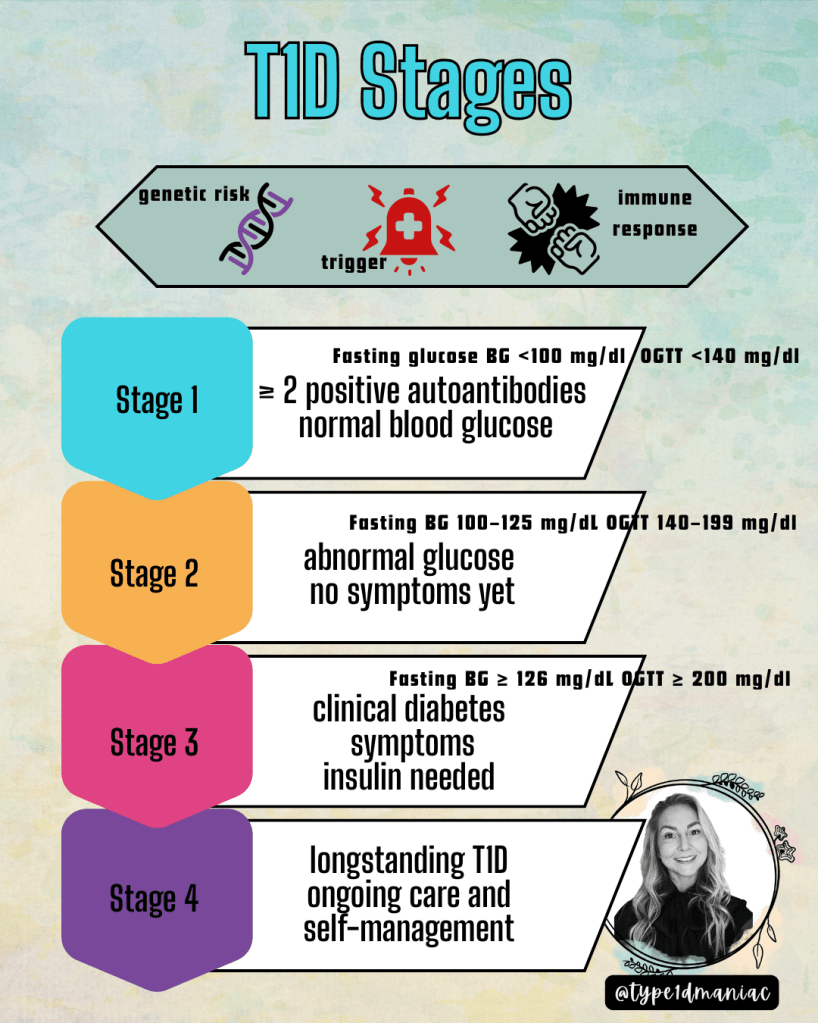
Eventually, both children were screened through a TrialNet study. The results were clear: Carter tested positive for four out of five diabetes-related antibodies. He also showed dysglycemia — blood sugars that were spiking into high ranges — and his A1C was elevated. It was the stage right before insulin would typically be required.
The news was heartbreaking. For the whole family, it was devastating to hear. Yet there was also relief in knowing that something could be done to delay progression.
As an epidemiologist, Jaime sat down with Carter and his dad to explain the evidence. On average, children with stage 2 type 1 diabetes progress to insulin within about two years. With Tzield, the median time is doubled to around four years. Some respond more strongly, some less — that’s how risk factors play out in any disease. She also explained the risks: a very small chance of cytokine release syndrome, a serious side effect that is monitored closely through regular bloodwork during treatment.
Despite the weight of the decision, Carter’s response was simple: “Well, mom, it’s worth it.”
From there, the hardest part was not medical — it was logistical. The family faced a long insurance battle. And, as Aubrey in Part I had also described, very few hospitals were trained to deliver the infusion. None were local, so Jaime and her family had to travel across the state to access care.
The infusion experience
To receive treatment, the family flew to another part of California, stayed in a rental home, and went to the hospital every day for Tzield. Carter had no side effects. Each day Jaime told him he was brave for coming in; he replied, “Mom, I’m not brave. This is nothing. We’re just sitting here getting infused.”
He felt well enough to exercise in the afternoons. They went on hikes and tried to make it feel like medicine and vacation at the same time.
One year later
One year after the infusion, Carter’s most recent A1C was 5.8 — slightly lower than before treatment. He remains off insulin and continues to do everything he enjoys, especially sports. For Jaime, that is no small thing: “Sports with diabetes is complicated. There are so many adjustments you need to make. It’s wonderful that he doesn’t have to do that now.”
The time bought by Tzield has also opened space for gradual learning. Instead of being overwhelmed with new skills all at once at diagnosis, the family has been able to talk about diabetes step by step — what a low blood sugar feels like, what a high looks like, how a pump works.
“Normally you get diagnosed and boom — you’re on insulin, you’re using a pump, you’re using a CGM, and you’re adjusting everything all at once. Now we have the opportunity to do that education slowly.”
Meals have even become teaching moments: Carter guesses the carb count, and Jaime helps him work through the math. “He’ll say 20, and I’ll tell him it’s 40 — and explain why. It gives us time to build that knowledge gradually instead of everything being forced in a single day.”
Looking back, Jaime is glad for the decision. “That’s been our experience with Tzield. I’m very happy we were able to do it.” She also values that screening allowed her family to contribute to science, while at the same time giving them precious time to prepare for the future.
Accepting the grace period
Jaime said that Carter knows this grace period will finish, and he is happy for the time he has before then. The initial news was a shock — he was devastated, and so was the whole family. But knowing that there was something they could do brought some relief.
They have made small changes at home to help with blood sugar spikes. “He doesn’t love those — but I don’t know what teenager does.” The family has introduced keto-style desserts and small meal adjustments, like swapping a second serving of rice for protein and vegetables, or choosing water instead of milk at high-carb meals. Jaime explained, “It wouldn’t work well emotionally to limit his carbs substantially right now… why would we fight about this?”
Sometimes Carter wears a CGM, which shows the difference. Low-carb meals keep his glucose close to normal, rarely above 140 mg/dL. High-carb meals can take him up to 240. Jaime compared this with her own experience: “If I go up to 240, it takes me hours. His highs come right down. I’m very jealous of how fast his highs come down.”
Stage 2, Jaime notes, is unpredictable. Blood sugars can swing higher for a few days, then settle back as the pancreas “turns on” again. It’s not quite normal, but close enough that it makes this period both strange and precious.
Balancing risks and side effects
Jaime admitted she had been concerned about side effects when they decided to go ahead with Tzield. “Like I mentioned, cytokine release syndrome happens very rarely, but it’s a really serious side effect. But it’s monitored.”
Every few days Carter’s labs were drawn, reviewed by the physician, and only if safe was the next infusion given. That process gave her reassurance. Other common effects, like itchy skin or drowsiness from Benadryl — an allergy medication often used to reduce infusion reactions — never became an issue for him.
“There’s always risk and benefit with any medicine. You have to weigh them. For us, we were comfortable. And since the infusion, totally fine. The day after, he was back at school, playing sports, doing everything normal.”
Look back
When Jaime thinks about the time they began this journey, she remembers how much they had to figure out on their own. Insurance battles were long, and no local center was able to provide the 14-day continuous infusion. The family had to travel, rent a temporary home, and learn the process as they went. Even very practical details — whether to use a daily IV or a port, when fluids like saline would be given, or waiting for a special team to find a vein — were only discovered once they were already at the hospital.
Since then, much has already changed. More hospitals are now trained to deliver Tzield, making access easier for families who follow. The peer community has also grown. Jaime found enormous value in a Facebook group where parents shared photos from infusion days, tips about what to bring, and encouragement from those who had been through it before. “Those weren’t medical questions, they were peer support — and it was really nice to have that.”
For Jaime, it feels meaningful to have been part of the very first wave. “We were told Carter was only the fourth pediatric patient treated there… one of the first hundreds of people in the world to get this drug.”
Looking back, she knows the struggle was worth it. And when she asked Carter if he would make the same choice again, his answer was straightforward.
“Yeah,” he told her. “Listen to your mom.”
Where we are today — practical overview
In the United States:
Tzield has been FDA-approved since November 2022 — as the first disease-modifying therapy in type 1 diabetes, to delay the onset of stage 3 in adults and children aged 8+ who are in stage 2. Access is improving, but as both Aubrey and Jaime’s stories show, it still often requires strong advocacy and persistence from families.
In Europe:
Sanofi submitted an application for approval to the EMA (European Medicines Agency) in December 2024. The review is ongoing, and approval has not yet been granted.
For now, Tzield is available only through compassionate use (early access programs).
- These programs allow some patients to receive treatment before full approval.
- They are open in Italy and Germany.
- Access is free of charge, strictly hospital-based, and always under medical responsibility.
- Families in other EU countries currently do not have this option, and cross-border treatment is not possible.
Closer collaboration is underway between Sanofi and international advocacy groups — but strict regulatory rules limit what companies can actively share. Families and advocates therefore often need to proactively seek out information themselves.
Learn more & stay connected
If you’re not familiar yet: INNODIA is an international non-profit initiative that brings together researchers, clinicians, industry, and people living with type 1 diabetes — with one clear goal: to accelerate the development of new therapies, support treatments that change the course of the disease, and one day make type 1 diabetes a thing of the past.
Through INPACT, the patient and parent community within INNODIA, we can:
- Follow and better understand what is really happening in type 1 diabetes research.
- Bring our voices and lived experience into clinical studies, new therapies, and access policies.
- Connect with others across Europe and learn from each other.
- Help ensure that people with T1D are truly at the center of future care.
💙 If this article resonated with you, share it forward — every verified source shared makes a difference. Help good information travel faster than myths. Subscribe for more. 💙
 #type1dmaniac