I haven’t told you yet, but in September, after much thought and encouraged by requests from some members, I finally organized a virtual meeting for Italian Loopers using open-source systems.
I’m talking about all those people I often hear from briefly—when quick answers, encouragement, or support during emergencies are needed. Loop and Learn Italia, the Facebook group for Italian open-source Loopers, is much more than just an online community: it’s a point of reference for those facing the same challenges. I hope to continue the incredible work that others started long ago, even before I ever imagined entering the world of type 1 diabetes.
Why organize this meeting?
Every month, after the Open Mic sessions with Loop and Learn international, many of you ask me a recurring question: “When will something like this be available in Italian?” Indeed, even for those who have access to systems like Loop, AndroidAPS, and other open-source tools, the language barrier often limits discussion and sharing, as most resources and support are in English. Language is a fundamental aspect. Creating this sharing space was a step to break down that barrier, making the learning and exchange experience accessible to everyone.
I must say that the stories and discussions that emerged left me with deep thoughts and crucial questions. In this space – without doctors and without recordings – everyone felt free to express themselves in a way that rarely happens. I heard stories of daily life that once again showed me the resilience of the Italian community and its desire to live life to the fullest, despite such an overwhelming illness.
A new technological world: opportunities and complex challenges
Let’s start with the heart of the matter: DIY technology has changed the lives of many of us. Using systems like Loop, AndroidAPS, and other open-source solutions is a revolutionary experience that allows for more independent management and often improves the quality of life. However, this autonomy comes at a cost: time, study, and dedication.
Many speak of the effort required to set parameters and make adjustments, a task that becomes exhausting during intense periods. And the question arises: what happens to those who lack the time or technical expertise? Perhaps it’s time to make these tools simpler and more accessible to a wider audience.
The issue of healthcare support: a help that is (almost) always missing
Healthcare assistance in Italy is a sensitive issue even within our DIY community, and the stories I’ve heard confirm a deep inequality. Experiences vary drastically from one region to another and sometimes even between nearby cities. Some are lucky enough to have found open-minded diabetologists, doctors who have educated themselves about DIY systems, while others, despite some reservations, have agreed to support them. Then, there are those who share stories about doctors who barely agree to renew the treatment plan, or worse, actively discourage them from using these tools.
During the discussion, it was highlighted that support from the healthcare system is limited due to the complexity of DIY systems and to a fear and skepticism toward these approaches. Some professionals still prefer to stay on the sidelines. We ask ourselves: how could we better train and engage healthcare personnel so their support becomes a real resource?
Regional disparities: Italy of a thousand obstacles and creative solutions
The meeting revealed a divided Italy: there are significant regional differences in access not only to diabetes technology. While some share stories of doctors prescribing sensors and insulin pumps without obstacles, others must fight the system just to obtain ultra-rapid insulin. These barriers not only generate frustration but also considerable stress. Some parents speak of the daily struggle to find solutions that could improve their children’s lives, facing hurdles such as the cost of ultra-rapid insulin for minors, a cost that shouldn’t even exist. Living with diabetes as a parent involves complexities that are hard to comprehend for those who have never experienced this reality. Yet, many of these parents show extraordinary resourcefulness: they work tirelessly to find ways to make their children’s lives more manageable, despite the challenges posed by the system and the limitations of available commercial solutions.
The real question is: how can we ensure equal access to tools and support, regardless of one’s region of residence? It’s not just about obtaining the latest sensor or the most advanced insulin pump, but about guaranteeing that everyone has the opportunity to live a calmer and more fulfilling life.
Healthcare professionals and open-source: a path still to be explored
Another crucial point that emerged concerns the involvement of healthcare professionals in the DIY world. Our community needs informed and open healthcare figures, but many diabetologists seem to be on uncertain ground. Their support is often vague or sporadic unless they are professionals with a genuine passion for technology and a personal interest in DIY systems.
There is official recognition of open-source systems, but it has not been widely disseminated: it remains confined to a few very limited environments. This lack of transparency complicates the situation, and many professionals, lacking well-publicized guidelines, prefer not to get involved, leaving users to navigate the DIY world on their own.
The future we want to see is one of greater collaboration, where doctors can offer support that respects the users’ autonomy but also provides a lifeline in times of uncertainty. A future in which the open-source approach is consciously and constructively integrated into the healthcare system, for the benefit of all.
Different needs of various groups
After our first “closed-door” meeting, we managed to organize a second appointment, this time open to everyone. The idea was to start with a brief training introduction and then leave space for discussion. With the aim of beginning with a training session and continuing with a discussion, the event highlighted an important aspect: existing open-source users who are already integrated into the community are more interested in sharing and openly talking with each other, rather than receiving a training portion. It’s clear that these two things cannot coexist in the same meeting.
On the other hand, healthcare professionals also have specific needs. They require a basic guide, tailored and supported by official organizations, that helps them address situations where the clinical world intersects with the challenges of real life. I am confident that together we will soon be able to create such a resource, because only by working in synergy we can build a support system that always places at its core the well-being of those who live every day with this relentless disease. (In the meantime, anyone who wants to suggest ideas or share their needs can write to me directly at type1dmaniac@gmail.com)
Finally, there is a group that often remains on the sidelines of these discussions: users who start using the applications without having followed any training. To them, I say: it’s never too late to get informed! Finding reliable resources and joining communities like Loop and Learn and Loop and Learn Italia is essential for anyone who wants to educate themselves in a mindful and responsible way.
I firmly believe in the strength of people and their ability to grow. Together, we can build a more collaborative future, based on knowledge and mutual respect.
The hope of a community that never stops
In conclusion, what this meeting has left me with is a certainty: our community is extraordinary, and its strength lies in sharing. Every experience, every piece of advice, every tip on how to tackle a technical issue or manage a complex scenario is a valuable resource.
And as we look to the future, we cannot help but ask ourselves how to make this journey less complex, more inclusive, and, most importantly, sustainable.
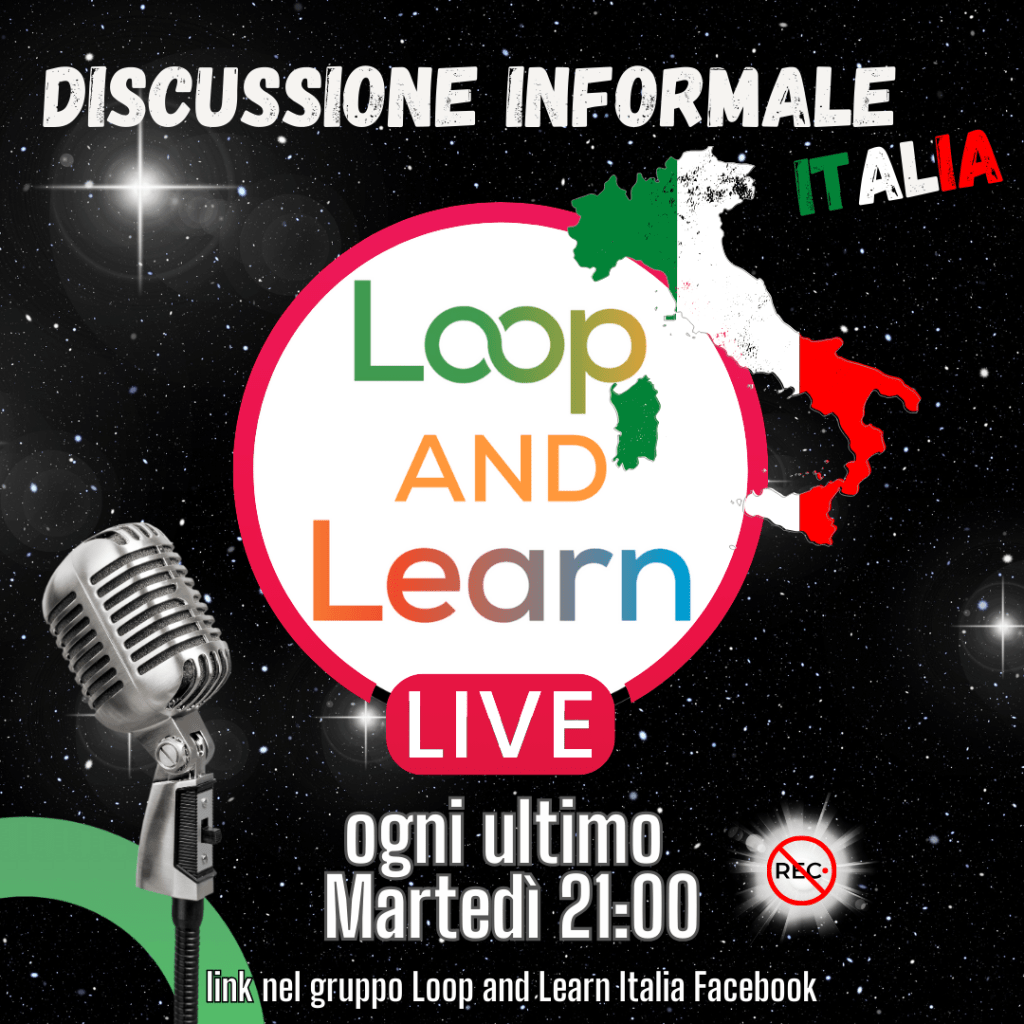
For this reason, I am thrilled to announce that, after these initial “trials,” together with Patrick Sonnerat, as administrators of Loop and Learn Italia, we have decided to hold a regular virtual meeting for our community on the last Tuesday of every month at 9:00pm CET. (For details and to participate, you’ll find the link in our Loop and Learn Italia group. Our International Open Mic in english language are held every second Thursday of the new month at 8 PM CEST, visit Loop and Learn group for details.)
With my background in the iOS world and Patrick, a key figure in Android looping and Nightscout, we want to offer a space where everyone—users and newcomers alike—can feel included, heard, and supported. It’s a valuable opportunity where the iOS and Android worlds can meet, share, and grow together. A unique chance to connect and break down the barriers that often separate these two platforms.
I sincerely want to thank Patrick for agreeing to dedicate his time to this cause, balancing professional and family commitments. It’s never easy, and certainly not something to take for granted, but he has done it with great generosity and with the same #payitforward spirit that I share, expecting nothing in return.
I’m excited to see where this journey will take us. Because there’s no doubt that by coming together, we can overcome every barrier and build a future where every voice is heard and every need respected.
 #type1dmaniac