Did you know that up to 98% of medicines that go through trials never reach the patient?!
The development of a medicine takes at least 12 years. It costs 1 billion dollars, and whoever successfully reaches its registration is protected by a 20-year patent before competitors can create a similar drug with a generic name.
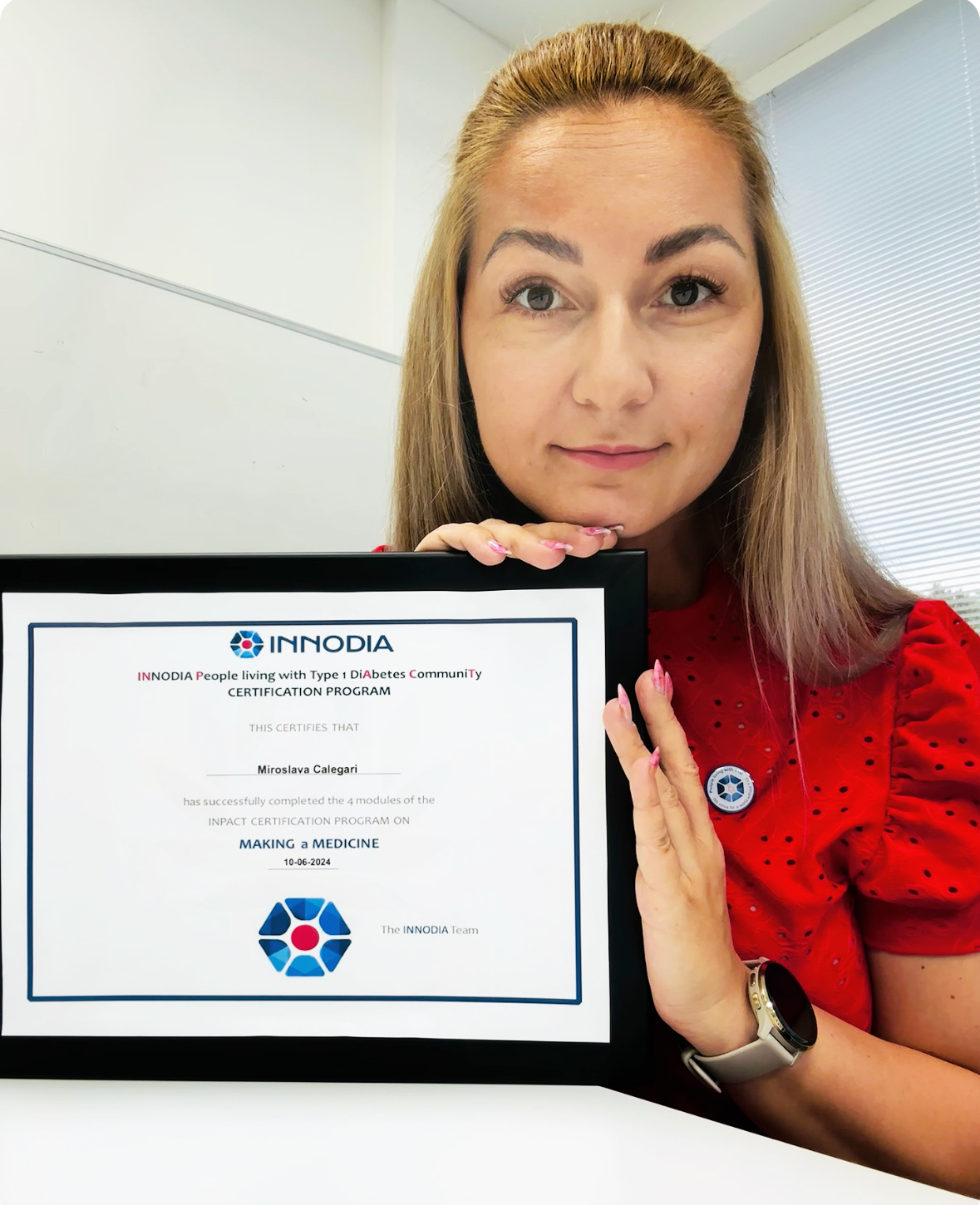
I gained these and many other important insights through the INNODIA INPACT “Making medicines” certification program, which officially welcomed me into the community of Certified INPACT Associates.
My Beginnings with INNODIA
I came across INNODIA while actively searching for information a few weeks after my daughter was diagnosed with type 1 diabetes (T1D) at the beginning of 2021. Like many other parents, I discovered through internet research the possibility of screening (testing for the presence or risk of a disease before it manifests) family members for the risk of T1D.
Some in the community have surely heard of the TrialNet research in the United States; in Europe, its equivalent at that time was called INNODIA. My initial excitement quickly faded when I learned that we could not participate in INNODIA screenings or ongoing research because we lived in Slovakia. To this day, there is no certified partner, institution, or laboratory in Slovakia for participation in various phases of the research. As a result, neither adults nor children with diabetes have the opportunity to participate in (or often even know about) studies and possibilities for delaying or potentially curing type 1 diabetes. This also delays the availability of possible treatments that successfully gain registration in the European Medicines Agency.
Obstacles Along the Way
Over the past three years, I have continually followed the progress of INNODIA. Through my studies and active participation in the most prestigious global conferences on type 1 diabetes, I learned last year that this European project is nearing its end. Today, screening for early detection of type 1 diabetes is mandated in Italy, and more and more countries are joining pilot projects for widespread testing. Currently, Slovakia is not among them. Just when I thought the dream of bringing INNODIA to Slovakia had faded, I received an email from Manuela Battaglia (Managing Director of Innodia.org) inviting me to a meeting to discuss the possibilities of involving Slovakia in the INNODIA network and accelerating the process of disease-modifying therapies for T1D.
First Steps Towards Change
I gathered over 150 contacts, including universities, academies, experts, scientists, national organizations, and even the presidential palace—everyone who should be aware of the latest developments in INNODIA. At the beginning of March, an online meeting was organized for Slovakia, with about 8 invitees from the list deciding to participate. In April, the first network event with in-person attendance took place in Leuven, Belgium, and this time, I was not the only Slovak there. The meeting was also attended by a young promising diabetologist from Poprad, Ivan Mrázik, representing the Slovak Diabetes Society, which subsequently applied for membership in INNODIA.org.
For me, this first small step represents significant satisfaction. However, whether and how quickly the presence of the INNODIA network will transfer to Slovakia and become a reality for people will not depend solely on me. In the world of diabetes, as elsewhere, learning from global leaders and keeping pace at the forefront requires more than individual determination and willpower. It demands time, effort, investment in one’s own education, and personal sacrifices—for both personal and professional growth. But if you refuse to settle for anything less than cutting-edge approaches to modifying and treating type 1 diabetes, then there is no clearer choice than INNODIA.org.
Why is it Important to Pay Attention to Type 1 Diabetes?
Type 1 diabetes is a chronic lifelong disease that can affect anyone, regardless of age or family history. Its prevalence is rapidly increasing. According to T1DIndex.org, in Slovakia, type 1 diabetes is growing at a rate of 5.2% annually compared to 2.3% for type 2 diabetes. This means that while today type 1 diabetes affects one in 40 families in Slovakia (for comparison, in 1990 it was one in 120 families), by 2040 it will be a reality in every seventeenth family. Slovaks with type 1 diabetes lose 24 years of healthy life. Nearly 4,000 people could still be living.
If we were to completely ensure the availability of insulin pumps and continuous glucose monitoring sensors for everyone, we could potentially restore 6 years of healthy life to people. However, by focusing on early prevention and curing of this disease, we can give back life to those affected. Hence, the motto of Innodia.org is clear: “We strive for a world without Type 1 Diabetes.” The organization primarily focuses on the European region and is built on solid, longstanding foundations of research and the dedicated work of some of the most renowned experts in the field.
Conclusion
Despite facing challenging times as a country, where citizens are contributing towards the rebuilding of hospitals… we are not alone in coming together for a noble cause and not waiting for type 1 diabetes to be solved without us.
Slovakia is still a grey area on the map in preparing for a life without diabetes. I believe we can change this situation, but it will require effort from all of us. With pleasure, we at Innodia.org will show you the way.
More at Innodia.org
Check out the first Innodia.org Network meeting through my eyes in my public album on Facebook.
 #type1dmaniac